



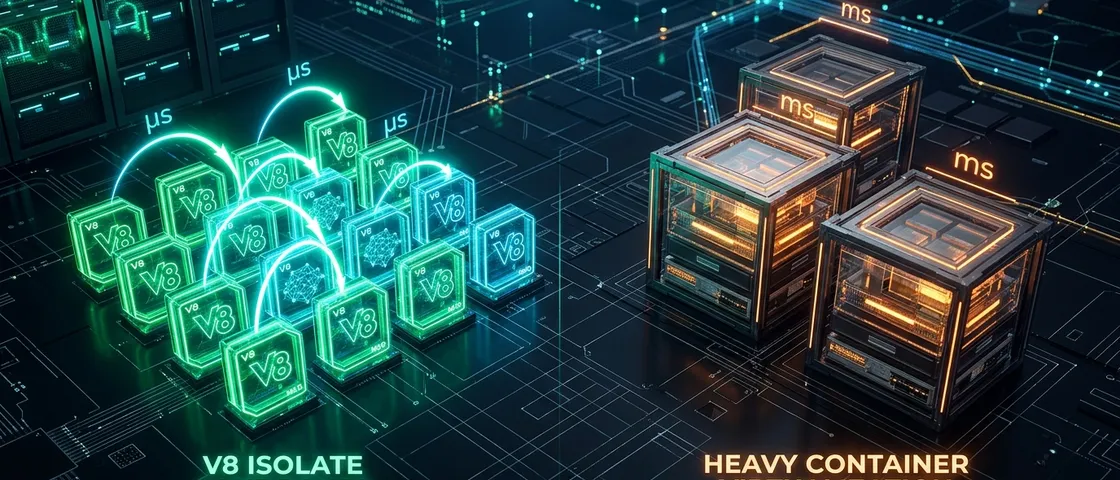
During the last decade, Linux containers (Docker, OCI) have consolidated as the standard for packaging and executing microservices. However, the intrinsic overhead of initializing a kernel namespace (kernel namespaces), cgroups, and an operating system image generates friction for ultralight workloads at the Edge. V8 Isolates represent a paradigm shift towards memory isolation at the execution engine level.
1. The Anatomy of Cold Start
The cold start time of a typical container in AWS Lambda or Google Cloud Run ranges between 200 ms and 1.5 seconds, depending on the image layers and runtime initialization (JVM, Node.js, or Python).
In contrast, a V8 Isolate in Cloudflare Workers is instantiated in less than 5 milliseconds:
| Metric | Traditional Linux Container | Cloudflare V8 Isolate |
|---|---|---|
| Cold Start Time | 200 ms – 1500 ms | < 5 ms |
| Base Memory Footprint | 35 MB – 128 MB | < 3 MB |
| Isolation Mechanism | Linux Namespaces + cgroups | V8 Heap memory contexts |
| Density per Physical Server | Hundreds of containers | Tens of thousands of Isolates |
2. The Cooperative Single-Threaded Concurrency Model
Within an Isolate, JavaScript/WebAssembly code execution is deterministic and non-blocking. I/O operations to Cloudflare KV, D1, or external services are dispatched using Promises managed by the event loop (Event Loop):
/** * Pipeline de ejecución concurrente en V8 Isolates * Resolución asíncrona sin sobrecarga de hilos de sistema operativo. */export async function handleRequest(request, env) {  const cache = caches.default;  const cacheKey = new Request(request.url, request);
  // 1. Verificación en caché perimetral (sub-milisegundo)  const cachedResponse = await cache.match(cacheKey);  if (cachedResponse) {    return cachedResponse;  }
  // 2. Fetch concurrente hacia D1 y Workers AI  const [dbResult, aiResult] = await Promise.all([    env.D1_DB.prepare("SELECT * FROM telemetry LIMIT 1").first(),    env.AI.run("@cf/meta/llama-3.1-8b-instruct", { prompt: "Ping" })  ]);
  const response = new Response(JSON.stringify({ dbResult, aiResult }), {    headers: { "Content-Type": "application/json" }  });
return response;}3. Conclusion
For zero-latency oriented APIs, routing middleware, and modern SSR web applications with Astro, V8 Isolates offer superior performance by eliminating cold start penalties and reducing infrastructure costs to a minimum.
[ Continue Exploring ]
Mitigation of L7 Attacks and WAF in Cloudflare Edge with V8 Isolates
Deterministic Real-Time Translations with Cloudflare Workers AI
Knowledge Base · 200+ Manuals
Verified Linux, Windows Server, hybrid Cloud, networking and cybersecurity procedures.
Consultancy & Contact
Cloud architecture, DevSecOps audit, hybrid infrastructure or technical collaboration.