



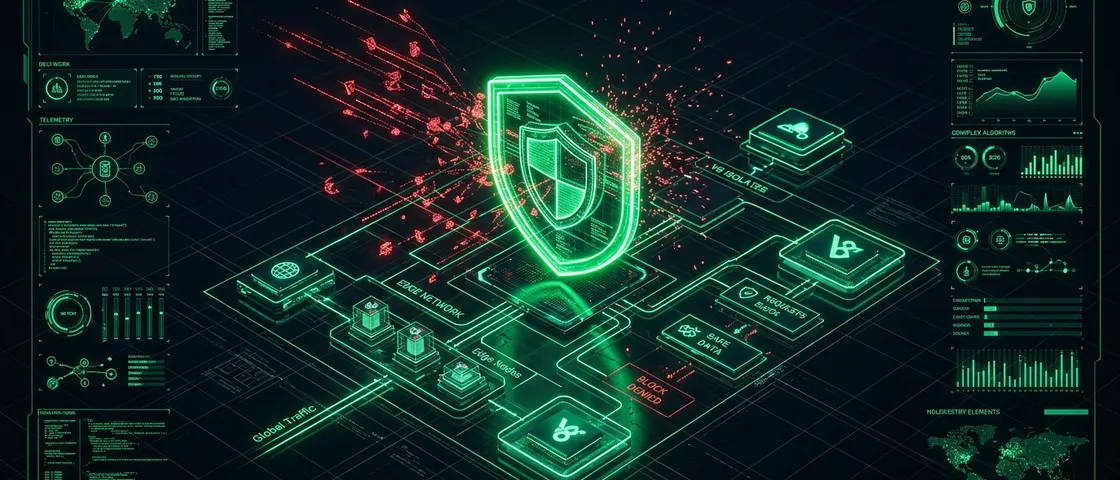
Attack vectors targeting the Application Layer (L7) have evolved from simple HTTP floods to highly distributed asymmetric bursts that faithfully mimic the browsing behavior of legitimate users. This analysis details the perimeter defense architecture implemented in Portelcore Web, combining Web Application Firewall (WAF) rules, cryptographic HMAC verification at the Edge, and automatic countermeasures executed on V8 Isolates.
1. L7 Attack Asymmetry
Unlike volumetric saturations in Layer 3/4 (SYN floods, UDP amplification), L7 attacks consume resources directly in the rendering stack, databases, and computing middleware:
[ CLIENTE ATACANTE ] ---> (Inundación HTTP POST /search) ---> [ ORIGEN: CPU 100% ] [ MEMORIA AGOTADA ] [ HTTP 504 TIMEOUT ]The perimeter objective is to intercept and mitigate malicious traffic before it reaches the Pages Functions Isolates or the origin server, resolving the security evaluation in less than 2 milliseconds.
2. Cryptographic Inspection using HMAC Token Buckets
For critical forms (such as 2FA mail dispatch or scheduling), traditional CAPTCHA validation is combined with an HMAC-SHA256 token with a timestamp:
/** * Valida la firma HMAC de una petición entrante en el Edge. * Previene ataques de repetición (Replay Attacks) verificando la ventana temporal. */export async function verifySecurityToken(  token: string,  secretKey: string,  maxAgeSeconds = 300): Promise<boolean> {  const parts = token.split(".");  if (parts.length !== 2) return false;
  const [timestampStr, receivedHmac] = parts;  const timestamp = parseInt(timestampStr, 10);  const now = Math.floor(Date.now() / 1000);
  if (isNaN(timestamp) || Math.abs(now - timestamp) > maxAgeSeconds) {    return false; // Token expirado o reloj desfasado  }
  const encoder = new TextEncoder();  const key = await crypto.subtle.importKey(    "raw",    encoder.encode(secretKey),    { name: "HMAC", hash: "SHA-256" },    false,    ["verify"]  );
  return await crypto.subtle.verify(    "HMAC",    key,    hexToBytes(receivedHmac),    encoder.encode(timestampStr)  );}
function hexToBytes(hex: string): Uint8Array { const bytes = new Uint8Array(hex.length / 2); for (let i = 0; i < bytes.length; i++) { bytes[i] = parseInt(hex.slice(i * 2, i * 2 + 2), 16); } return bytes;}3. WAF Topology: Rate Limiting by JA4 Fingerprint
Traditional blocking based solely on IPv4/IPv6 addresses is insufficient against botnets that rotate residential IPs. Portelcore's architecture uses JA4 TLS fingerprints to identify automated bot families:
| Parameter | Production Configuration | Effect |
|---|---|---|
| Rate Limit Window | 60 seconds | Rolling count in perimeter memory |
| Request Threshold | 30 requests / minute | Activation of Managed Challenge |
| Matching Criterion | http.request.uri.path contains "/api/" | Strict isolation of mutation endpoints |
| Response Action | HTTP 429 with header Retry-After | Cost-free infrastructure mitigation |
4. Conclusion and Resilience
By placing inspection at the Cloudflare perimeter control plane and coupling the backend to ultralight SSR functions, the operational cost of mitigating millions of malicious requests is reduced to zero, maintaining continuous 99.99% availability across all global Points of Presence (PoPs).
[ Continue Exploring ]
V8 Isolates vs. Containers: Low-Latency Serverless Architecture
Deterministic Real-Time Translations with Cloudflare Workers AI
Knowledge Base · 200+ Manuals
Verified Linux, Windows Server, hybrid Cloud, networking and cybersecurity procedures.
Consultancy & Contact
Cloud architecture, DevSecOps audit, hybrid infrastructure or technical collaboration.